
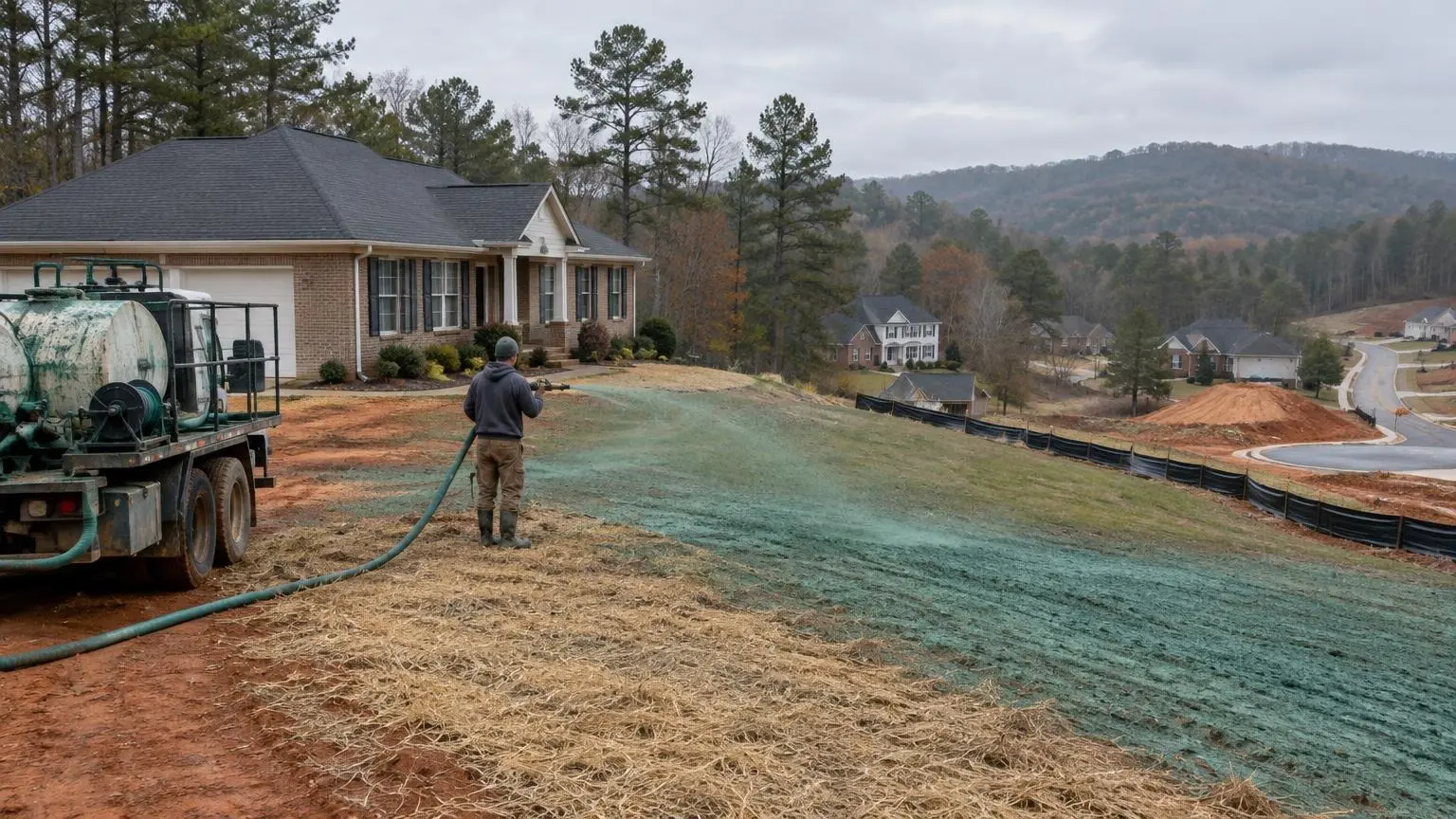
Piedmont Triad lawns and job sites
Hydroseeding in Greensboro, NC
Seed, mulch and fertilizer sprayed onto red clay ground, timed for the fescue season and built to hold through summer storms.
- No-charge visit to the property and an itemized quote in writing
- Seed mixes and timing matched to Piedmont clay and tall fescue season
- Silt fence and seeding planned around the state's 21-day stabilization rule
Growing Grass on Greensboro Clay
Hydroseeding in Greensboro starts with the ground under the seed. The city sits among the rolling hills of North Carolina's Piedmont, and the soil that dominates the region is the Cecil series, the state soil: a brown sandy loam over thick red clay. On most lots that have been farmed, graded or built on, the sandy loam is thin or gone, and seed lands on clay. Our rig mixes seed with wood fiber mulch, fertilizer and a tackifier in a tank of water and sprays that blend over the bare clay, so the seed ends up covered, anchored and kept damp while it sprouts. We seed new lawns, builder lots, commercial sites and slopes, and we install the erosion control and silt fence that keep bare ground from leaving the property before the grass fills in.
What the red clay does to a new lawn
Cecil clay is dominated by kaolinite, and soil scientists note that it has little ability to recover from compaction. That matters on every new-construction lot in Guilford County. Skid steers, concrete trucks and pallets of brick roll over the yard for months, and by the time the house is finished the top few inches can be as hard as a driveway. Seed sprayed onto that surface may sprout, but roots stall at the crust, rain sheets off instead of soaking in, and the stand thins out by its first July. Before we seed, we rip or till compacted areas, spread topsoil where the original layer is missing, and shape the final surface to shed rain off and away from the foundation. NC State Extension suggests a 2 to 3 percent slope away from buildings, and we grade to that where the lot allows. The clay is also naturally acidic, so a soil test and lime are often part of a good start.
Rain, heat and the seeding calendar
NOAA's 1991 to 2020 normals for Piedmont Triad International Airport show about 43.95 inches of precipitation a year, with every month from June through September above four inches. Summer storms are the main threat to bare ground: a hard afternoon rain on a freshly graded lot cuts rills in an hour. The same record shows about 32 days a year reaching 90 degrees, and roughly 75 nights at or below freezing. Autumn, by comparison, brings fewer rainy days and less total rain than spring, along with cooling nights, which is exactly what young cool-season grass wants.
Which grass, and when to plant it
Most Greensboro lawns are tall fescue. NC State Extension calls it the best grass to plant if you want a year-round green lawn and lists it as best adapted to the mountains and Piedmont. Cool-season grasses like fescue are best seeded from mid-August to October 1, depending on location; seeding later raises the risk of winter injury, and spring seeding often fails because roots cannot get established before summer heat and drought. If fall seeding is missed, the Piedmont fallback is mid-February to early March. Bermudagrass and zoysiagrass, which suit sunny commercial strips and some home lawns, are planted from late spring into July. When a builder needs cover in the wrong season, we can put down a temporary grass to hold the soil and come back with the permanent seed in the right window.
Choosing among sod, hydroseed and a spreader
Sod gives an instant lawn, but it costs the most and still has to root into the same clay, so compacted ground causes the same problems underneath it. Broadcast dry seed is the cheapest option but leaves seed exposed to birds, wash and drying out, which on a sloped clay lot often means bare streaks after the first storm. Hydro seeding sits in between on price. The mulch layer holds moisture against the seed, the tackifier glues it to slopes, and the green tint shows exactly where coverage landed. University of Nebraska Extension puts first visible growth from hydroseeding at roughly 5 to 7 days, compared with two to three weeks for dry seeding. For a typical Greensboro yard, hydroseeding is the practical middle choice.
State rules on bare ground
North Carolina's Sedimentation Pollution Control Act, passed in 1973, covers land-disturbing work across the state. According to NC DEQ, erosion and sediment control is required regardless of the size of the disturbance, an approved plan is needed before grading on sites over one acre, and graded slopes must be vegetated or otherwise stabilized within 21 calendar days of finishing a phase of grading. Guilford County and Winston-Salem/Forsyth County run their own delegated programs, and local rules can be stricter than the state's. That is why our builder and commercial work often pairs hydroseeding with fabric fencing, storm drain guards and rolled blankets on the steeper cuts.
What a Greensboro job looks like
We start with a site visit: we look at the soil, check for compaction, find where water enters and leaves the yard, and measure the area. The written estimate spells out prep, seed mix, mulch rate and any blankets or silt fence. On seeding day we spray the slurry in overlapping passes, heavier on slopes. Afterward you water lightly and often for the first few weeks, then back off as the grass roots in. Tall fescue is usually ready for its first mow when it reaches about 4.5 inches, cut back to 3. Get a free estimate
Who we work for
Homeowners with a new house and a bare yard, families redoing a lawn that has gone thin under old oaks, builders who need lots stabilized before inspection, and site contractors who need slopes, swales and basins covered. Across the Triad, we are one of the hydroseeding companies that also handles the grading, topsoil and erosion control around the seed, so the job does not stall waiting on another trade.
We also get calls from people who tried seeding themselves and watched it wash into the street after one storm. That is not a sign the yard cannot grow grass. It usually means the clay was packed, the seed was not covered, or it went in during the wrong month. Those are all fixable, and a short site visit is usually enough to tell which one it was. If your lawn needs only overseeding rather than a full hydroseed lawn, we will tell you that too.
Seeding Across the Triad
We work throughout Greensboro and out across Guilford, Forsyth, Alamance, Davidson, Randolph and Rockingham counties. Close in, that means High Point, Jamestown, Summerfield, Oak Ridge and Stokesdale, where acreage lots, horse pasture and lake-area homes are common. To the west we cover Kernersville, Winston-Salem, Clemmons, King and Bermuda Run, where creek banks and the Yadkin River valley add slopes to many jobs. East of the city we work in Gibsonville, Elon, Burlington and Graham along the Haw River side of the region. South and southwest, Archdale, Thomasville, Lexington, Asheboro and Randleman bring heavier clay, lake-watershed lots and the first hills of the Uwharries. North, Reidsville and Eden sit closer to the Dan River. Pick a town below for the soil, water and slope quirks we plan around in that part of the Triad.
- Hydroseeding in Greensboro, NC
- Hydroseeding in High Point, NC
- Hydroseeding in Summerfield, NC
- Hydroseeding in Oak Ridge, NC
- Hydroseeding in Stokesdale, NC
- Hydroseeding in Jamestown, NC
- Hydroseeding in Kernersville, NC
- Hydroseeding in Winston-Salem, NC
- Hydroseeding in Clemmons, NC
- Hydroseeding in Burlington, NC
- Hydroseeding in Graham, NC
- Hydroseeding in Gibsonville, NC
- Hydroseeding in Elon, NC
- Hydroseeding in Archdale, NC
- Hydroseeding in Thomasville, NC
- Hydroseeding in Lexington, NC
- Hydroseeding in Asheboro, NC
- Hydroseeding in Randleman, NC
- Hydroseeding in Reidsville, NC
- Hydroseeding in Eden, NC
- Hydroseeding in King, NC
- Hydroseeding in Bermuda Run, NC
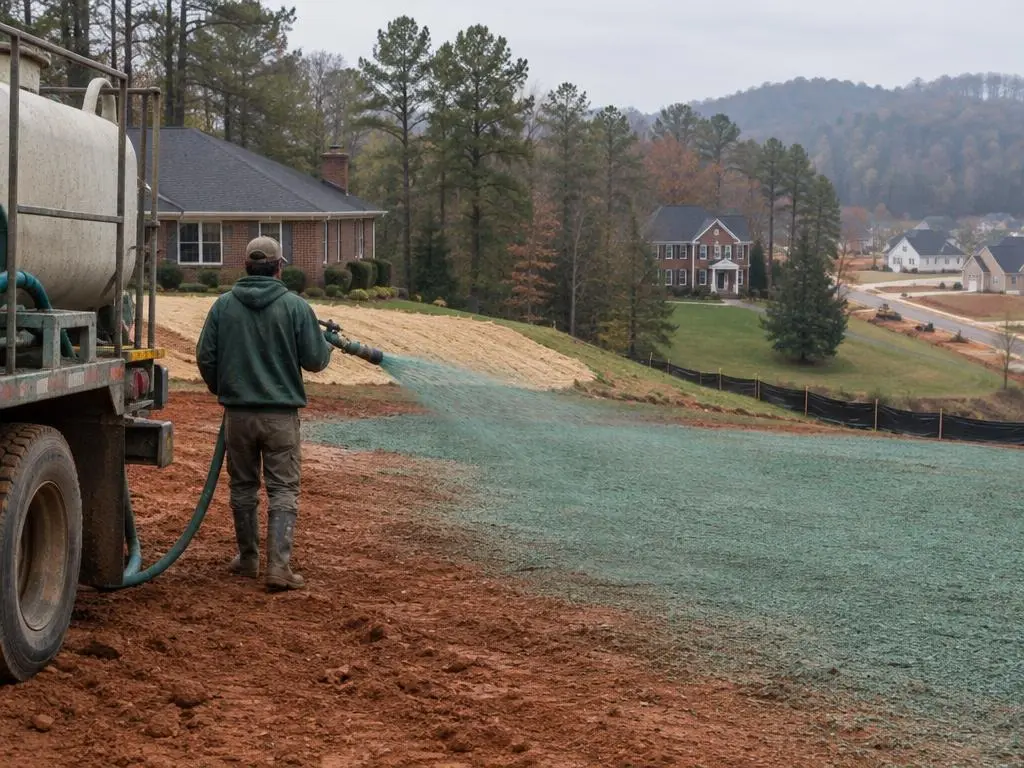
Why Homeowners Call Hydroseeding Greensboro
Clay-first prep
We check compaction and topsoil depth before quoting, because seed on hard red clay is where most failed lawns here begin.
Seeded in season
We plan tall fescue for the early fall window and warm-season grass for late spring and summer, and we tell you when waiting will give a better lawn.
Erosion control in-house
Silt fence, inlet protection, blankets and bonded fiber matrix come from the same crew that sprays the seed.
Plain written estimates
Prep, seed, mulch and erosion items each get their own line, so every dollar on the quote has a label.
Common Questions
How much does it cost to hydroseed half an acre?
National cost guides put it roughly between $1,300 and $5,500: HomeAdvisor lists $1,300 to $4,400 for a half acre and HomeGuide lists $3,500 to $5,500. Where your yard lands depends on how much prep the clay needs, the slope and access. Once we have walked the yard, we put a total in writing and that total does not creep up later.
Does hydroseeding actually work on red clay?
Yes, when the clay is prepared first. Compacted clay is the usual reason seed fails, so we loosen it, add topsoil where it is missing and grade for drainage before spraying. The mulch layer then keeps the seed moist and in place on bare clay, which dry seed cannot do.
What grass grows best in Greensboro?
For most sunny-to-partly-shaded home lawns, tall fescue. NC State Extension lists it as best adapted to the Piedmont and the best choice for a lawn that stays green year round. Bermuda and zoysia work for hot, full-sun areas but go brown after the first heavy frost.
Which months give Greensboro fescue seed its strongest start?
For tall fescue, early fall. NC State Extension recommends seeding cool-season grass between mid-August and October 1 depending on location, with mid-February to early March as the Piedmont fallback. Bermuda and zoysia are seeded from late spring through July.
How long before a hydroseeded lawn can be mowed?
Usually four to six weeks under good conditions. With tall fescue, mow once it reaches about 4.5 inches and take it back to 3 inches, never shorter than 2.5.
Do I need an erosion control permit to seed my yard?
Seeding an existing yard does not usually need one. Grading or clearing is different: North Carolina requires an approved erosion and sedimentation control plan for disturbing more than one acre, and Guilford County runs its own local program, so check with them for smaller sites too.
What watering schedule does fresh hydroseed need through a Triad summer?
Short, light rounds several times through a hot day, enough to keep the mulch damp without puddling. On clay, short frequent watering works better than long soaks that run off. Taper off as the grass roots in over about three weeks.
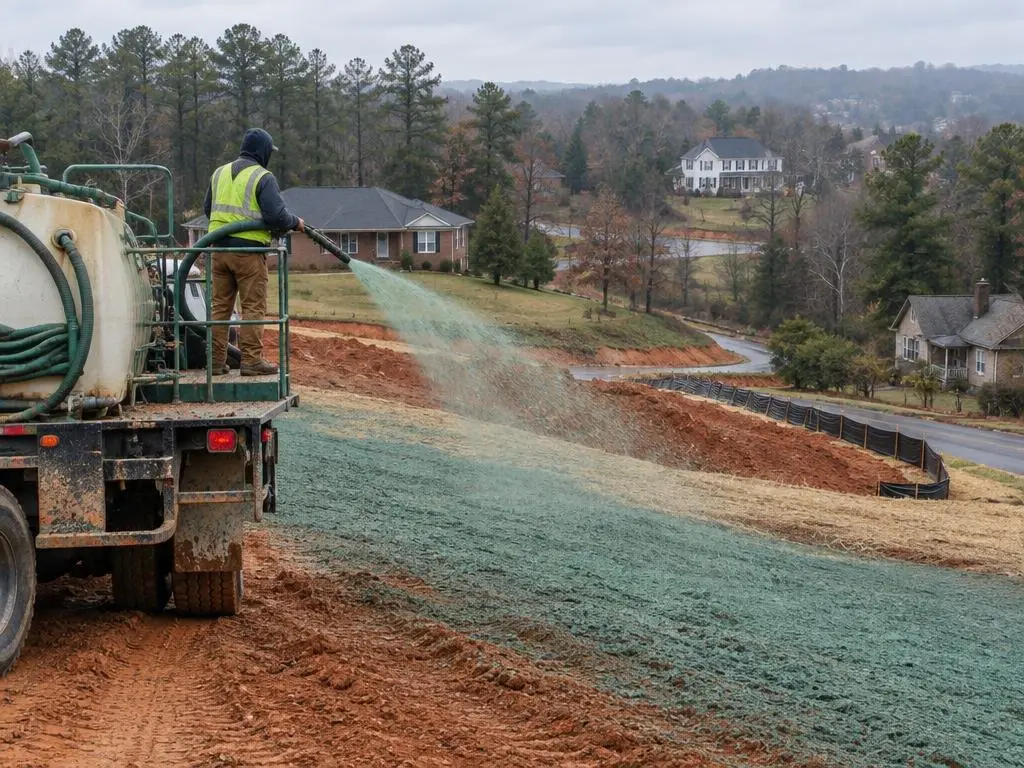
Our Services
The six jobs we take on across the Triad, from a single Greensboro back yard to a graded commercial pad.
Home Lawn Hydroseeding
New tall fescue lawns sprayed onto prepared clay, for new houses and yards that need to start over.
Learn more →Builder Lot & Commercial Seeding
Hydroseeding for builders, site contractors and commercial properties that need ground covered and stable.
Learn more →Erosion Control Blankets & Hydromulch
Straw and coir blankets, heavy hydromulch and bonded fiber matrix for slopes, ditches and banks that keep washing out.
Learn more →Silt Fence Installation
Trenched silt fence, inlet protection and sediment control for building lots and site work.
Learn more →Yard Grading & Red Clay Prep
Grading, topsoil and dirt work to get compacted clay ready for a lawn and moving water away from the house.
Learn more →Fescue Overseeding & Lawn Repair
Overseeding thin fescue, repairing bare patches and renovating tired lawns in the fall window.
Learn more →Bare Clay in the Yard? Let's Take a Look
No-cost visit to your lawn, lot or slope, then an estimate in writing.